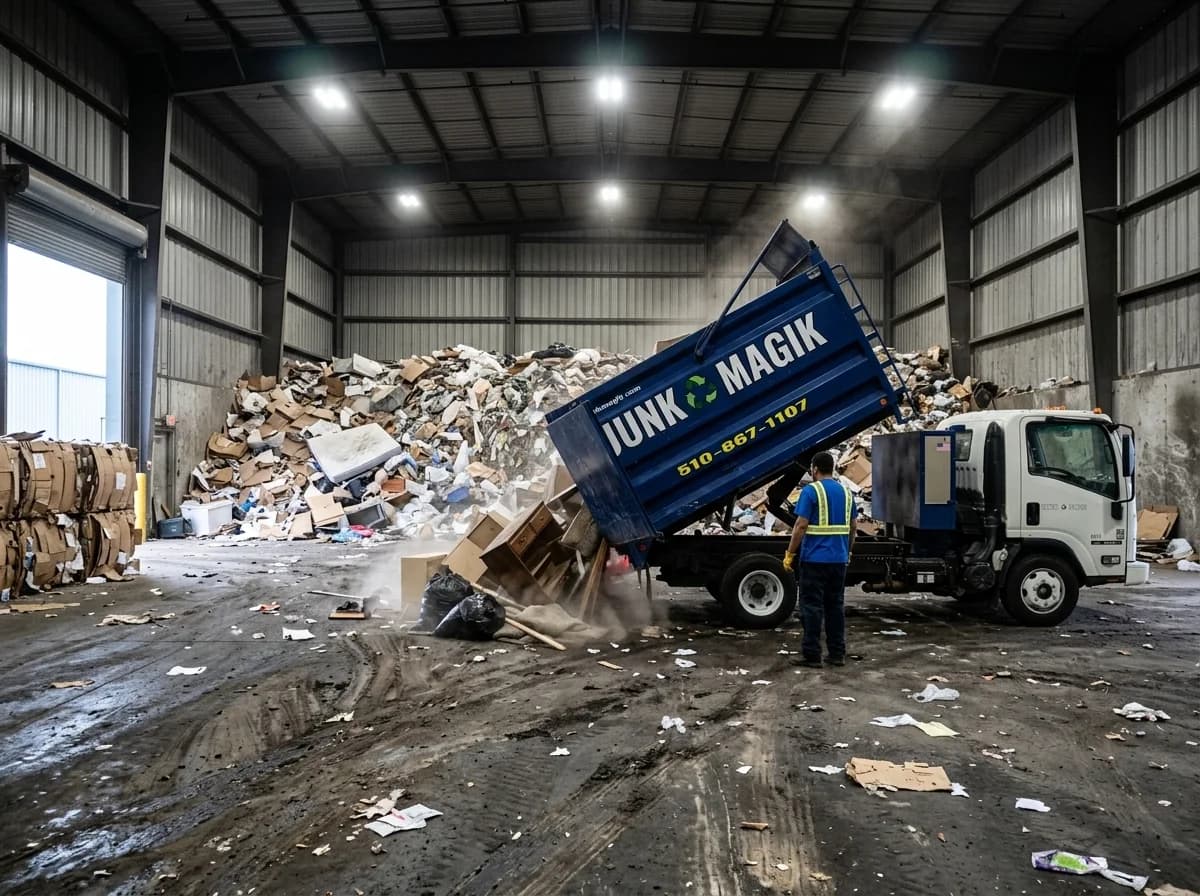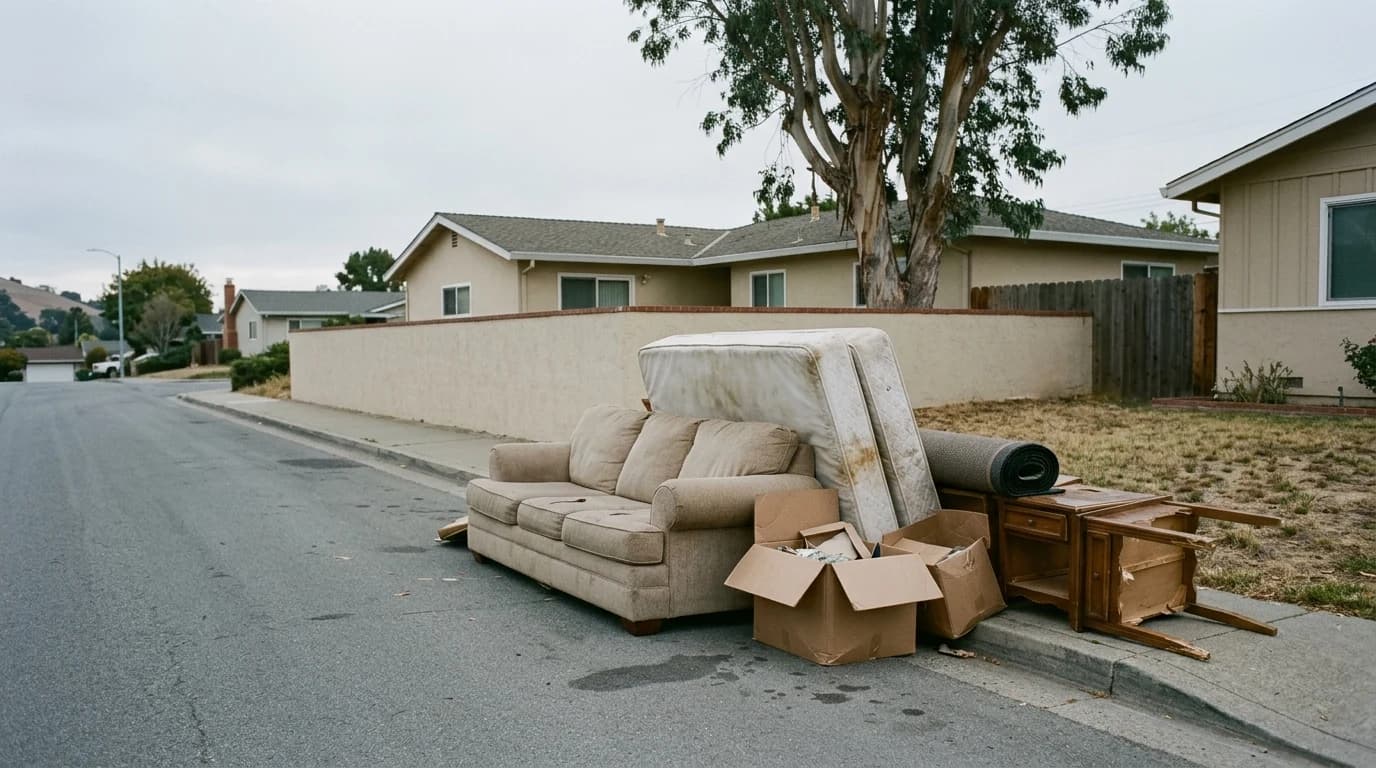
There are four realistic ways to get a pile out of your house, and one of them is free.
We are a junk removal company, so you can guess which one we would like you to choose. But you should know about the free one, because for some jobs it is genuinely the right answer — and because finding out about it after you have paid someone is a bad way to find out.
Here is all four, honestly, with what each actually costs in money, time and effort.
Option one: your city's free bulky item pickup
Most Bay Area cities include one or two free bulky item pickups a year as part of the garbage service you already pay for on your utility bill. It is not a special program you have to qualify for. It is already yours, and most people never use it.
The general process is the same almost everywhere:
- You call your hauler or book online and request a pickup
- They give you a date, usually tied to your normal collection day
- You set the items at the curb the night before
- A separate truck comes and takes them
Here is where to start, depending on where you are:
- City of Hayward — two pickups per calendar year for single-family homes, duplexes, triplexes and fourplexes
- Oakland Recycles — curbside pickup and an annual drop-off option
- City of San José — request through 311
- City of Fremont — through Republic Services
- RE:Source by StopWaste — searchable directory for the rest of Alameda County
Programs differ city to city and they change, so check your own before you plan around it.
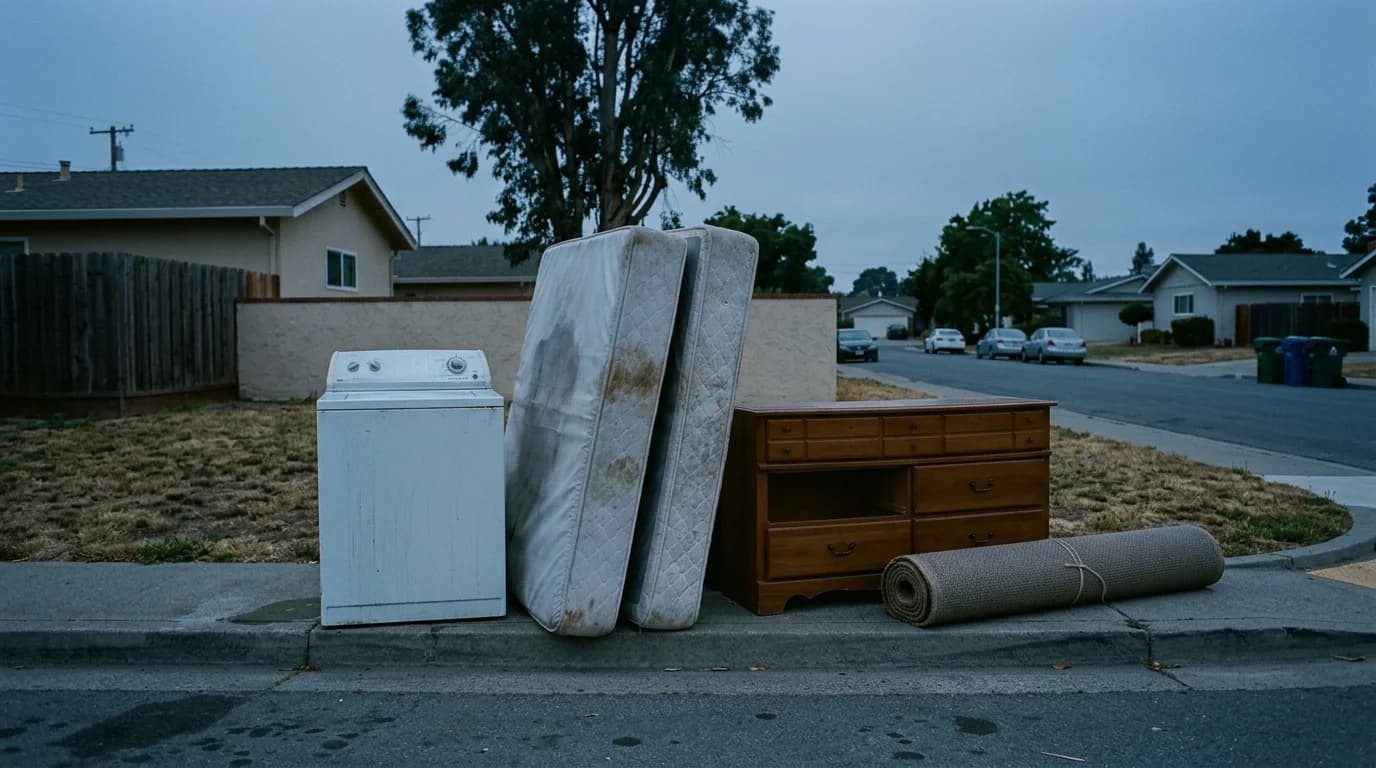
What the free option actually costs you
Nothing, in dollars. The cost is in the other three currencies.
You wait, and you live with it while you wait. This is the big one, and it is bigger than the calendar. Appointments are commonly a couple of weeks out, longer during moving season, after the holidays, and any stretch where the hauler is catching up. Some programs pause entirely around late December.
But the wait is not an abstraction. That mattress is somewhere for those two weeks. It is blocking half the garage, or standing in the hallway, or leaning in the spare room you wanted back. You booked the pickup to be rid of the thing, and you are still looking at it every day until the truck comes.
Then it sits at the curb. Set-out is the night before, so it spends at least one night outside — longer if you set it out early because you will be at work. A mattress that catches rain is a heavier, wetter mattress. Furniture on a curb is an invitation, and it is common for other people to add their own things to a pile that has already appeared. Now the pile is bigger than what you booked, and the crew takes your items and leaves the additions. Cities also enforce blight and illegal dumping rules, and a pile that sits too long can become your problem rather than the hauler's.
And you do not really know it is handled until it is gone. You get a date, not a time. There is no crew texting you an ETA. If the truck comes and goes while you are at work and something is still sitting there, you are calling the hauler to work out why, and your options are to wait for the next available date or deal with it yourself. For a job with a real deadline behind it, that uncertainty is the part that costs the most.
If they do not take everything, the leftovers are yours. This is the outcome people do not plan for. Go over a category limit and the crew takes what fits and leaves the balance at the curb — correctly, by their rules. Same if something is not on the accepted list, or is over the weight limit, or was not set out the way the program requires. You wanted an empty curb and you now have a smaller pile, no truck coming, and your one or two annual pickups already spent.
There is a cap, and it is per pickup, not per truck. Cities count categories separately — so many pieces of furniture, so many appliances, so many mattresses, so many electronics, so many tires, and an overall volume limit on top. A garage cleanout blows through that in one corner. Go over the cap and the crew takes what fits the limit and leaves the rest at your curb.
You only get one or two a year. Use your allotment in March on a couch and the October cleanout is on you.
Set-out rules are real. Items have to be at the curb, not in the garage, not behind a gate, not in the back yard. Carpet usually has to be rolled and tied. Nobody comes inside, nobody carries anything down stairs, and nobody moves what you did not put out.
If you rent, it may not be yours to schedule. In most cities multi-family properties arrange bulky pickup through the property manager rather than the resident. If your manager is slow, that is the actual timeline.
What no city program will take
This list is broadly consistent across the Bay Area, and it is where most people get stuck:
- Household hazardous waste — paint, solvents, motor oil, pesticides, pool chemicals, batteries
- Construction and demolition debris
- Dirt, rock, brick and concrete
- Medical and biohazard waste
- Single items over a weight limit, commonly around 75 pounds, with furniture and appliances treated separately
Hazardous material has its own route. Every Bay Area county runs a household hazardous waste drop-off that takes most of it free from residents — Alameda County's program is reachable at 1-800-606-6606. That is genuinely the right place for it, and no legitimate hauler will take it off your hands instead.
There are edge cases inside those categories — a paint can that dried out years ago is not the same problem as a full one. Ask, and we will tell you straight either way.
Option two: borrowing a truck from someone you know
The classic. It works, and it is the cheapest paid option, but count the real cost before you commit to it.
You are coordinating two schedules to land on the same free Saturday. You are doing the lifting, and so is whoever you asked — which is a favor you will owe back. You are paying for gas. You are still paying the disposal fee at the other end, because the dump does not care whose truck it is.
And it is one truck. A load that does not fit becomes two trips, or a second Saturday.
Where this wins: one or two manageable items, a friend who genuinely offered, and no deadline.
Where it goes wrong: anything heavy, anything down a staircase, anything where you find out mid-lift that a full-size fridge does not go in a pickup bed with two people.
Option three: renting a truck yourself
You can rent a pickup or box truck by the day from any of the rental companies. Nothing wrong with them — it is just worth seeing the whole bill before you decide.
An in-town rental is typically a day rate plus a per-mile charge, and the miles include driving to get the truck, driving to the transfer station, and driving it back. Fuel is on you. You have to return it on time and reasonably clean. Then you still pay the disposal fee.
And you are still the labour. The truck solves transport. It does not solve carrying a sleeper sofa down a flight of stairs.
Two things people leave off the estimate. The first is their own time — if you would not work a Saturday for free, then loading, driving, queueing at the scale, unloading and returning the truck is not free either, and it is most of a day. The second is that you are now responsible for a vehicle. Damage coverage is usually optional and declining it puts the repair on you, returning a truck dirty after a dump run can draw a cleaning charge, and bringing it back late costs more. None of that is likely. All of it is possible, and none of it exists on the other options.
One thing people underestimate: the transfer station is not open whenever you are. The Davis Street facility in San Leandro, the main one serving this side of the bay, runs weekdays and Saturday and is closed on Sundays. Self-haul loads are charged by weight or volume, with separate per-item fees on things like appliances and tires, and weighed loads can require a deposit at the gate. Check current rates before you go, and do not plan a Sunday dump run.
Option four: hiring a junk removal service
What you are actually buying here is not a truck. It is everything around the truck.
The truck already exists and it is already paid for. The crew is already assembled and insured, so the lifting is not yours and neither is the risk of a wrenched back on your own staircase. The disposal fees, the sorting, the transfer station trip and the recycling routing are handled and rolled into one number. And the timing is yours rather than a queue — same-day and next-day slots when they are open, rather than a date the hauler assigns you two weeks out.
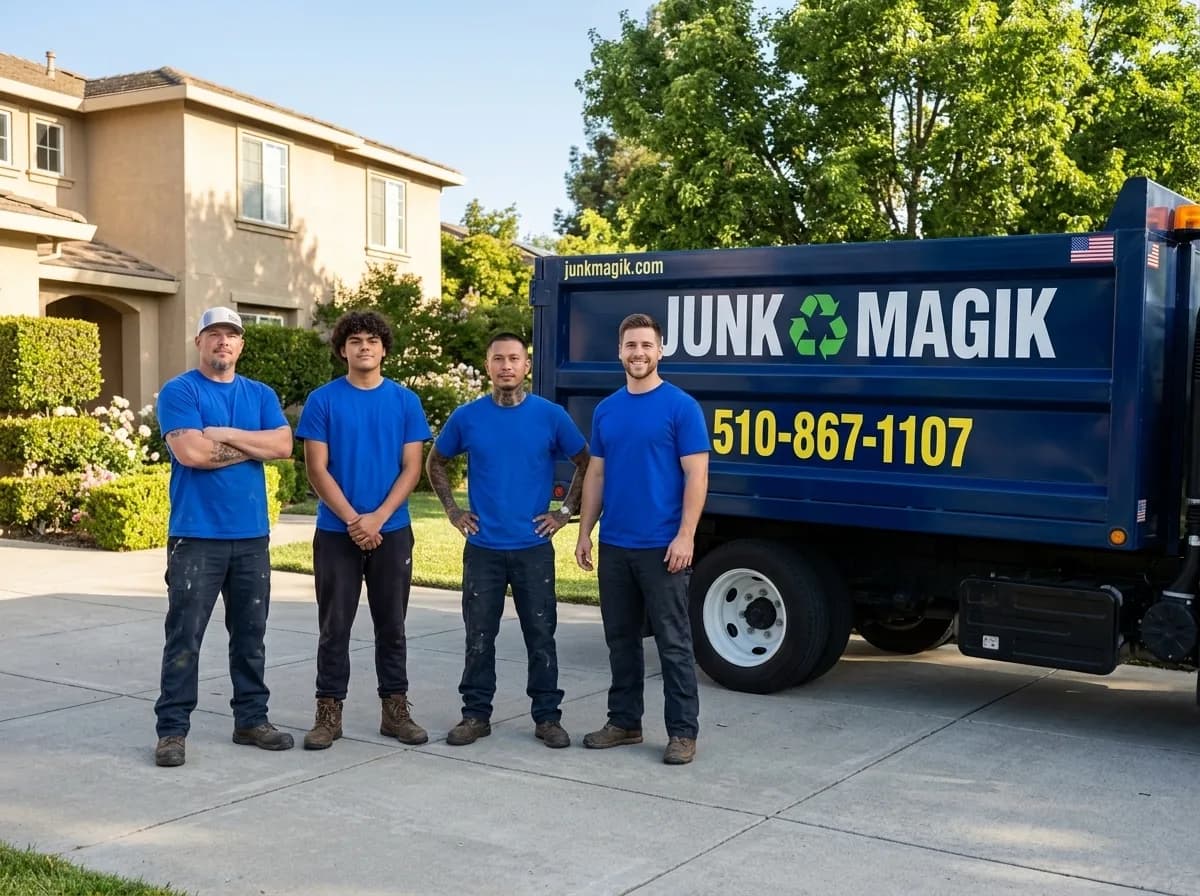
We also take a wider range than a city program does. Furniture, appliances, mattresses, e-waste, yard debris, construction debris, and full garage, estate and commercial cleanouts. Not hazardous material — see above, nobody legitimate takes that — but most of what actually fills a garage.
People file this as the expensive option. It is worth actually checking that.
Every route except the city pickup has a bill attached. The rental has a day rate and a per-mile charge and a tank of fuel. The borrowed truck has fuel and a favour you owe back. Both of them still pay the same disposal fee at the gate that we do, and both of them cost you a Saturday — and if you put any number at all on your own hours, even a modest one, that line is rarely small. Add it honestly and the gap is usually narrower than people expect. On a full load it can close.
The difference is what you are left holding. On the other routes, if something goes wrong — the load does not fit, the fridge will not go down the stairs, the transfer station closes before you get there — it is still your problem. On this one it is not.
So which one should you pick?
A rough guide, and we will tell you straight if you call and the answer is one of the other three.
Use your city pickup when you have one or two items that fit the category limits, you can get them to the curb yourself, you have somewhere to keep them in the meantime, and you genuinely do not mind when they disappear. It is free. Use it.
Borrow a truck when the load is small, the help is genuinely offered, and nothing is heavy or awkward.
Rent a truck when you want to control the timing, you are comfortable with the whole job being yours, and the volume justifies the day rate plus miles plus fuel plus dump fees.
Call a service when any of these are true: you are on a deadline, the volume is past what a city pickup allows, the items are heavy or upstairs or behind a gate, you are clearing a whole space rather than removing a few things, or you simply want it gone today instead of in two weeks.
That last one is not a lesser reason. A lot of what we pick up is a single mattress or one couch that someone did not want sitting in their hallway for another fortnight. Paying to skip the wait is a legitimate reason to pay.
The thing that actually decides it
For most people it comes down to a single question: does this need to be gone on your schedule, or on someone else's?
If you can wait, the free option is there and you should use it. If you cannot — because a tenant is moving in, the house is going on the market, a relative's place has to be cleared, or you are just done looking at it — that is exactly what a service is for.
Not sure which bucket you are in? Tell us what you have and we will give you an estimate before anyone lifts anything, and if your city pickup is the better call for your situation we will say so. Book a pickup online or get in touch. We cover the East Bay, Tri-Valley, Peninsula, South Bay and beyond.
Written by Junk Magik
All guides